
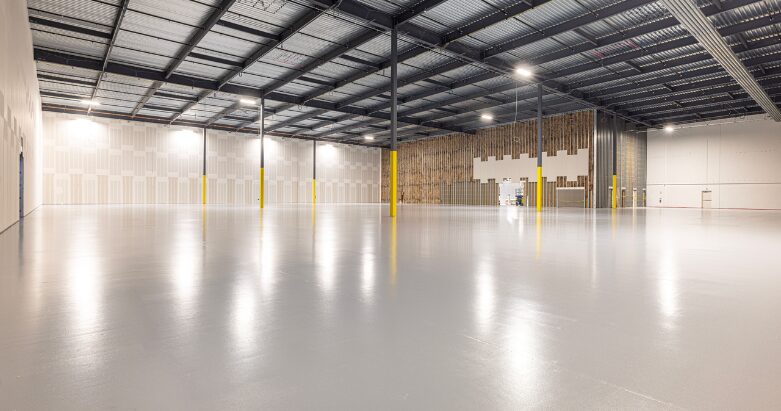
The floor of a warehouse works harder than almost any other surface in a commercial or industrial facility. Day after day, it absorbs the weight of forklifts, pallet jacks, foot traffic, and the slow drip of chemicals, oils, and cleaning agents. Most standard concrete floors were never designed to handle that kind of abuse for decades on end. Cracks form. Stains set in. Dust becomes a constant problem. Then comes the question every facility manager eventually faces: is it time to coat this floor, and if so, what type of coating actually holds up? Epoxy flooring for warehouses has become the standard answer for good reason.
When installed correctly and matched to the right conditions, an epoxy system protects concrete, reduces maintenance time, improves safety, and can last well over a decade. The catch is that not every epoxy system is built for every facility. Choosing the wrong product, or skipping critical steps in surface preparation, leads to peeling, bubbling, and premature failure. This post breaks down exactly how to match an epoxy flooring system to your warehouse’s specific traffic load and chemical environment.
What Makes Epoxy Flooring the Right Choice for Warehouse Environments?
Epoxy is a two-part system: a resin and a hardener that, when combined, form a rigid, chemically bonded coating over concrete. The result is a seamless surface that resists moisture, impacts, abrasion, and many industrial chemicals. Unlike paint, which sits on top of concrete, epoxy penetrates and bonds directly to the substrate. That bond is what gives it durability standard floor paint simply cannot match.
According to industry research, properly installed epoxy floors in commercial and industrial settings last between 10 and 20 years with routine maintenance, compared to 3 to 5 years for standard concrete sealer. That lifespan difference translates directly into fewer disruptions, lower long-term maintenance costs, and more uptime for your operations.
Beyond durability, epoxy floors are easy to clean, resistant to bacterial growth, and available in finishes that improve light reflectivity, which can reduce the need for additional lighting in large warehouse spaces. Safety markings, anti-slip aggregates, and color-coded zones can all be incorporated directly into the coating system.
How Does Traffic Load Affect the Epoxy System You Need
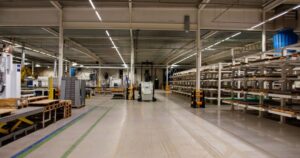
Traffic load is the first variable to assess before specifying any epoxy system. A distribution center running 30 forklifts across its floor every day needs a fundamentally different product than a storage room with light foot traffic. Getting this wrong is one of the most common reasons epoxy floors fail prematurely in warehouse settings.
Light-duty applications, such as office areas adjacent to a warehouse floor or low-traffic storage rooms, can use a standard two-coat epoxy system. These systems apply at 10 to 15 mils of dry film thickness and provide a clean, durable finish without the cost of a heavy-duty specification.
Medium-duty areas, including most general warehouse floors with regular forklift and pallet jack use, call for a thicker build coat, often combined with a urethane or polyaspartic topcoat. The topcoat adds UV stability and scratch resistance that standard epoxy alone does not provide. This combination handles daily loading and unloading operations without showing premature wear at turning points and high-traffic lanes.
Heavy-duty environments, such as manufacturing floors with continuous heavy equipment movement, require broadcast systems where functional aggregates are broadcast into the wet epoxy to add thickness and surface texture. Some specifications in these environments call for total system thickness exceeding 125 mils, with multiple intermediate coats and a commercial-grade urethane topcoat.
Which Chemicals Is Your Floor Actually Exposed To?
Chemical exposure is often where facility managers underestimate what their floor needs. Epoxy performs well against many substances, but it has real limitations. Knowing what your floor encounters regularly is the difference between a coating that lasts and one that degrades within a few years.
Standard epoxy coatings handle mild chemicals well. Lubricating oils, hydraulic fluids, most cleaning agents, and diluted acids fall within the tolerance range of a properly formulated epoxy. For warehouses where these are the primary chemical concerns, a standard epoxy system with a urethane topcoat is a solid choice.
Food processing facilities, pharmaceutical warehouses, and chemical storage areas present a different challenge. These environments often involve concentrated acids, caustic cleaners, or frequent high-pressure washdowns that standard epoxy cannot tolerate long-term. Novolac epoxy systems, formulated with a denser cross-link structure, offer significantly better resistance to concentrated chemicals and thermal cycling. They are the right call in any facility where chemical spills are not occasional accidents but part of daily operations.
Facilities dealing with fuel, solvents, or aggressive petroleum products may need a polyurethane or methyl methacrylate (MMA) system instead. MMA in particular cures fast, resists a broad range of chemicals, and performs well in cold environments where standard epoxy cures slowly or incompletely.
Why Does Surface Preparation Make or Break an Epoxy Installation?
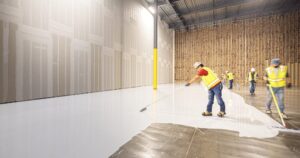
No epoxy system, regardless of quality, performs well over a poorly prepared surface. Surface preparation is the single most critical step in any resinous flooring project, and it is where shortcuts cause the most damage.
Concrete must be profiled before epoxy application. Shot blasting is the industry standard for warehouse floors because it opens the pores of the concrete and creates a mechanical profile for the coating to grip. The International Concrete Repair Institute (ICRI) rates concrete surface profiles from CSP 1 (lightly etched) to CSP 9 (heavily scarified). Most epoxy systems for warehouses require a CSP 3 to CSP 5, which shot blasting achieves consistently and efficiently.
Cracks, joints, and spalled areas must be repaired before coating. Applying epoxy over existing cracks does not seal them permanently. Thermal movement and structural settling will reflect those cracks back through the coating over time. A qualified contractor fills cracks with semi-rigid epoxy filler or polyurea, depending on whether the crack is static or moving.
Moisture vapor transmission is another factor many facilities overlook. Concrete is porous, and moisture migrating up from below can delaminate an epoxy coating even after a perfect installation. A moisture vapor barrier primer addresses this before the main system goes down. Skipping this step in facilities with slab-on-grade construction or high water table areas is a common cause of floor failure.
What Are the Most Common Mistakes Warehouses Make When Specifying Epoxy Flooring?
Choosing an epoxy system based on price alone is the fastest path to a floor that fails early. Thin, low-solids products cost less upfront but wear through quickly under forklift traffic and require recoating far sooner. The total cost of a low-quality installation, including downtime, recoating, and lost productivity, almost always exceeds the cost of a properly specified system from the start.
Another common error is applying epoxy over concrete that has not fully cured. New concrete needs a minimum of 28 days to cure before coating. Applying epoxy to concrete that is still releasing moisture vapor from the hydration process causes adhesion failure.
Skipping a topcoat is a mistake in nearly every commercial and industrial application. Raw epoxy yellows under UV light and shows wear patterns more quickly than a protected surface. A urethane or polyaspartic topcoat extends the life of the system, adds chemical resistance, and keeps the floor looking clean and professional for years longer.
Hiring a general painting contractor without industrial flooring experience creates problems too. Resinous flooring installation requires specific knowledge of mixing ratios, application temperatures, pot life management, and moisture testing. A contractor who applies epoxy occasionally is not the same as one who specializes in it.
How Do You Maintain an Epoxy Warehouse Floor Once It Is Installed?
Epoxy floors are low maintenance compared to unsealed concrete, but they are not zero maintenance. A consistent cleaning routine protects the surface and extends the coating’s lifespan.
Daily sweeping or dust mopping removes abrasive particles that, if left in place, act like sandpaper under forklift tires. Weekly wet mopping with a pH-neutral cleaner keeps the surface clean without breaking down the coating chemistry. Avoid ammonia-based or highly alkaline cleaners, which degrade epoxy and urethane topcoats over time.
Spills should be addressed promptly. Most chemicals that would damage an epoxy floor do so through prolonged contact, not immediate exposure. Wiping up spills within minutes prevents the extended contact time that causes staining or surface etching.
Periodic inspection for areas showing wear, especially at forklift turning points and dock areas, allows for spot repairs before small areas of damage spread. A qualified industrial flooring contractor can recoat worn areas without replacing the entire floor system, which keeps maintenance costs manageable across the life of the facility.
Frequently Asked Questions About Warehouse Epoxy Flooring
How long does epoxy flooring installation take in a working warehouse?
Most warehouse epoxy projects take two to five days depending on square footage, the number of coats in the specification, and curing time between coats. Many contractors phase the work in sections so portions of the facility remain operational during installation. Light foot traffic is possible within 24 hours of the final coat, while forklift traffic requires a full cure of 5 to 7 days.
Can epoxy flooring be installed over an existing coating?
In most cases, no. Existing coatings must be removed before new epoxy goes down. Applying a new system over an old one that is delaminating or compromised transfers the adhesion problem to the new coat. Shot blasting removes old coatings and prepares the concrete simultaneously, which is why it is the preferred prep method for warehouse floor projects.
What is the difference between epoxy and polyurea flooring for warehouses?
Polyurea systems cure much faster than epoxy, sometimes in as little as one hour, which reduces downtime considerably. They also offer better flexibility, making them less prone to cracking in environments with thermal cycling. The trade-off is cost: polyurea systems are more expensive than epoxy. For facilities where downtime is the primary concern, the faster cure time often justifies the price difference.
Does warehouse epoxy flooring require anti-slip additives?
In most warehouse applications, yes. A smooth epoxy finish becomes slippery when wet, which creates safety risks in loading dock areas, near wash stations, or anywhere liquids are present. Aluminum oxide or silica sand aggregates broadcast into the topcoat add texture without compromising the floor’s cleanability or chemical resistance. Many OSHA-compliant facility specifications require a measurable slip resistance rating for industrial floors.
How do you choose between a water-based and solvent-based epoxy for a warehouse?
Water-based epoxy systems have lower VOC emissions and are easier to work with in occupied facilities. Solvent-based systems offer higher solids content and better penetration into dense or contaminated concrete. For most standard warehouse applications, a high-solids water-based epoxy is sufficient. Solvent-based products make more sense in high-demand industrial environments where maximum film build and chemical resistance are the top priorities.
What does a resinous flooring project from Southeast Painters include?
Southeast Painters handles the complete process from concrete assessment and surface preparation through final coat application. Projects include moisture testing, crack repair, shot blasting or mechanical profiling, and a coating specification matched to the facility’s traffic and chemical conditions. The team works around operational schedules to minimize downtime and coordinates phased installation when full shutdowns are not possible.
Getting epoxy flooring right in a warehouse comes down to three things: understanding your traffic load, knowing your chemical exposure, and hiring a contractor who can match the specification to the reality of your facility. A floor that fails in two years because it was under-specified costs far more than doing it right the first time.
Southeast Painters has delivered industrial and commercial resinous flooring solutions across the Southeast for over 30 years. From distribution centers and manufacturing plants to hospitals and athletic facilities, the team brings the technical knowledge and hands-on experience to install flooring systems that hold up. Contact Southeast Painters at 423-558-3842 or visit southeastpainters.com to schedule a site assessment and get a detailed estimate for your facility.
