
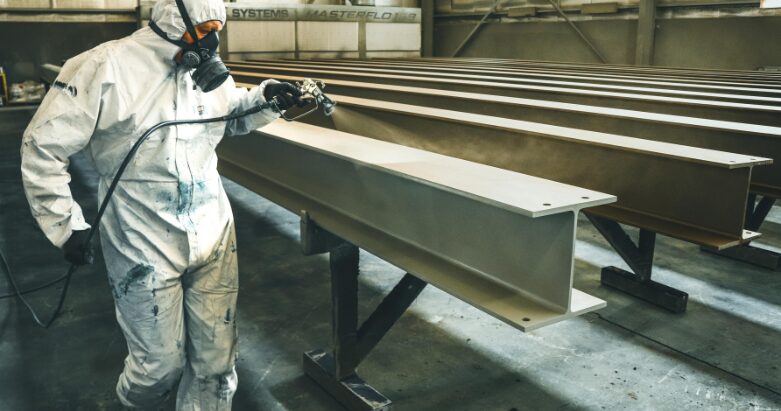
Surface preparation is the step that determines whether a coating system lasts two years or twenty. Get it right and every coat that follows bonds tightly, performs to spec, and protects the structure underneath. Get it wrong and the best paint in the world will fail. The debate between sandblasting and ecoblasting comes down to one practical question: which method gets your surface to the standard your project requires, under the conditions your facility presents?
Both methods are legitimate. Both remove rust, old coatings, mill scale, and contaminants from steel and other substrates. The difference is in how they work, what they leave behind, and which environments they are suited for. For facility managers, plant engineers, and property owners weighing sandblasting services against high-pressure water blasting, here is what actually matters.
What Is Sandblasting and How Does It Work?
Sandblasting, more accurately called abrasive blasting, propels abrasive media at high velocity against a surface using compressed air. The impact of the abrasive removes corrosion, coating, and contamination while simultaneously creating a surface profile on the substrate. That profile is measured in mils and gives the primer coat something to grip mechanically. Without it, even a well-chosen primer can fail at the adhesion stage.
The abrasive media itself has evolved well past sand. Modern abrasive blasting uses steel shot, steel grit, crushed glass, garnet, coal slag, and other engineered media depending on the surface type and the profile specification. Different media create different surface profiles and have different reuse rates, dust generation levels, and disposal requirements.
Abrasive blasting is the established standard for commercial and industrial surface preparation. When a coating specification calls for a near-white metal blast, abrasive blasting is the method that gets there most consistently.
What Is Ecoblasting and How Does It Differ?
Ecoblasting uses high-pressure water, rather than abrasive media, as the primary force for surface preparation. At pressures between 10,000 and 20,000 psi, high-pressure water blasting removes rust, coatings, and contamination from steel surfaces with precision and force. At ultra-high pressure (UHP), water blasting reaches up to 40,000 psi and can not only match the results of traditional abrasive blasting but exceed them in many conditions, using a fraction of the abrasive material involved in conventional methods.
The key difference is what the method leaves behind. Abrasive blasting leaves abrasive particles, dust, and debris that must be collected and disposed of. High-pressure water blasting produces water runoff and dislodged coating material. In environments where dust is a contamination risk, where workers or operations are nearby, or where abrasive waste disposal creates regulatory or logistical problems, ecoblasting removes a significant layer of complication.
Water blasting does not inherently create a new surface profile the way abrasive blasting does. On bare steel with no existing profile, that is a consideration. On steel being cleaned for overcoating where a profile already exists, water blasting cleans without disrupting the substrate or introducing embedded abrasive particles that can cause issues under certain coating chemistries.

How Do the Two Methods Compare Side by Side?
The clearest way to evaluate these methods is against the conditions that matter most on real projects.
Dust and airborne debris
Abrasive blasting generates significant airborne dust. Depending on the media and containment setup, this can travel and settle on adjacent surfaces, equipment, and products. In enclosed industrial facilities, food processing environments, or anywhere a dust-free workspace matters, controlling that debris requires additional containment, ventilation, and cleanup. Ecoblasting eliminates airborne dust entirely. The trade-off is managing water runoff and wet conditions in the work area.
Surface cleanliness and salt removal
This is where high-pressure water blasting has a clear advantage. Chloride salts are one of the primary drivers of premature coating failure on steel. Abrasive blasting removes visible contamination but does not always remove soluble salts embedded in pitted or corroded steel. Water at high pressure flushes those salts out of pits and surface irregularities. On steel in coastal environments, chemical plants, or any facility with salt contamination history, ecoblasting produces a cleaner substrate for coating adhesion.
Surface profile creation
Abrasive blasting creates the anchor profile that primers grip. If a project requires a specific mil profile on bare steel that has none, abrasive blasting achieves it directly. High-pressure water blasting cleans and exposes the existing profile but does not create one where none exists. For new steel going into a coating system for the first time, this is the factor that most often points toward abrasive blasting as the method of choice.
Waste disposal and environmental impact
Abrasive blasting generates spent media mixed with coating debris, rust, and potential hazardous materials (lead paint, chromate primers) that require proper disposal. Depending on the project and the contaminants involved, disposal costs add up quickly. Ecoblasting produces water-based waste that is often easier to manage and, in some cases, less costly to handle. For projects subject to environmental permitting or operating near water sources, that difference matters.
Containment requirements
Both methods require containment, but the type differs. Abrasive blasting requires shrouding, tarpaulins, and often negative pressure enclosures to control dust and debris. Ecoblasting requires berms or barriers to manage water runoff. In confined spaces or on structures where erecting containment is difficult, water blasting often requires less elaborate setup. In open outdoor environments, abrasive blasting can be more straightforward to contain, depending on wind and adjacent conditions.
Which Environments and Projects Point Toward Each Method?
There is no single right answer. The method that fits depends on what the project involves and what the facility can accommodate.
Abrasive blasting is the stronger choice when new bare steel needs a specific surface profile before priming, when the project is outdoors or in a well-ventilated area with room to contain debris, when the coating specification calls for SSPC standards that are defined around abrasive blast results, or when the facility can accommodate dry conditions and abrasive waste disposal is straightforward.
Ecoblasting is the stronger choice when the work is near occupied spaces, active equipment, or food production where dust contamination is not acceptable, when the steel has salt contamination that needs to be flushed rather than just abraded, when overcoating an existing system that already has a surface profile, when environmental permits or operating conditions restrict abrasive media use, or when working in a confined space where dust control is difficult to manage.
Can Both Methods Be Used Together on the Same Project?
They can, and on complex industrial projects this is sometimes the right call. A common sequence is to use abrasive blasting to establish the initial surface profile on bare steel, then follow with a high-pressure water wash to remove residual abrasive particles, soluble salts, and surface contamination before priming. The two methods complement each other. Abrasive blasting creates the profile. Water blasting cleans it.
On large-scale industrial recoating projects, it is also common to use ecoblasting for the bulk of the work on existing coated surfaces and reserve abrasive blasting for areas where spot-blasting to bare metal is required. A contractor with experience in both methods can specify the right combination for each zone of the project rather than applying a single method across conditions that call for different approaches.
What Should You Ask a Contractor About Their Surface Preparation Method?
The method a contractor proposes tells you a lot about how well they understand your project. A contractor who defaults to one method for every situation without considering the conditions is working from habit, not judgment.
- What surface preparation standard they are specifying and how their proposed method achieves it.
- Whether the existing steel has any salt contamination history and how they plan to address it.
- What containment setup they are planning and what the cleanup process looks like for your facility.
- Whether the coating system they are specifying has any compatibility considerations with the blasting media being used.
If a contractor cannot walk through these questions with confidence, that is worth noting. Surface preparation is not the glamorous part of a painting project, but it is the part that determines whether everything else holds.
If you are planning a coating project and need to talk through surface preparation options, call 423.266.6615 to get a project-specific recommendation.
