
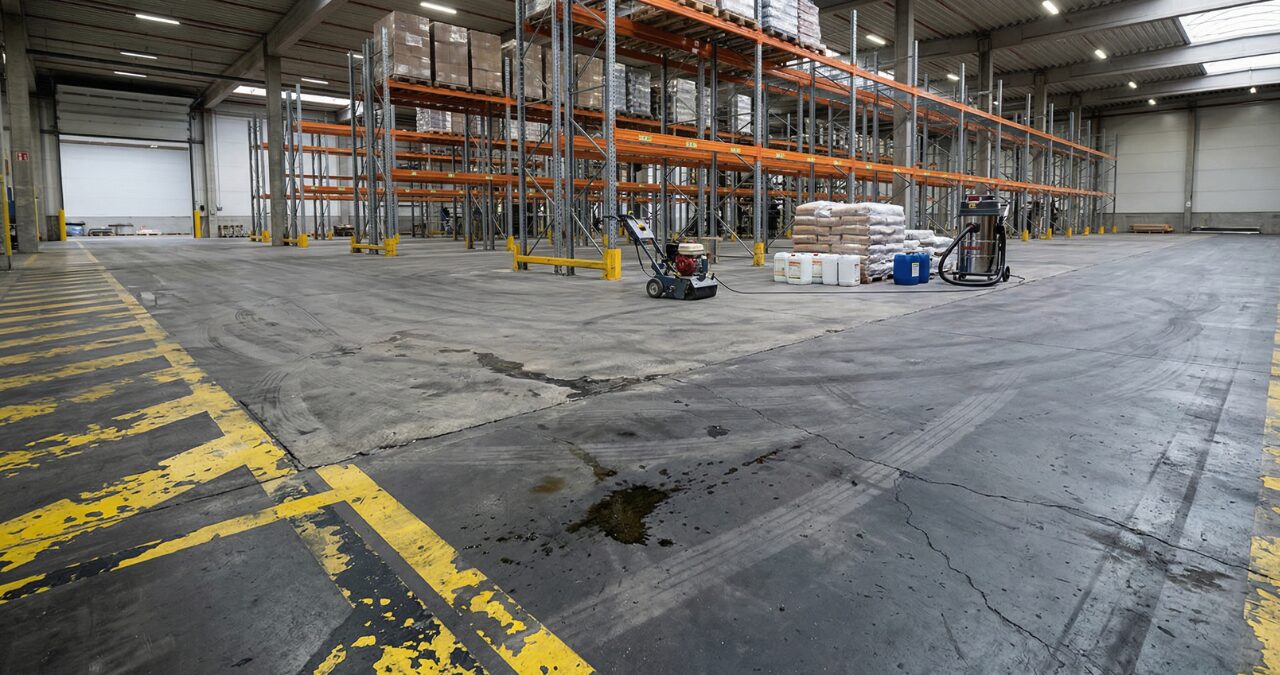
You’ve decided it’s time to do something about your warehouse floors. They’re cracked, stained, or just worn down from years of forklift traffic and heavy equipment. You know a quality floor coatings will protect your investment and make the space safer for your team. Then you start researching, and suddenly you’re staring at two options that both sound reasonable: epoxy and urethane.
Which one do you actually need?
It’s one of the most common questions facility managers ask when planning a warehouse flooring project. The honest answer is that it depends on your facility, your traffic, and how your floor gets used every day. This breakdown covers both options so you can make a confident, informed decision and avoid a costly mistake.
What Is Epoxy Floor Coating?
Epoxy is a two-component system made by combining a resin with a hardener. When mixed and applied, it creates a rigid, highly durable surface that bonds directly to concrete. It’s been the go-to choice for warehouse flooring for decades, and the results speak for themselves.
Epoxy coatings handle forklift traffic well, resist most chemicals and oils, and give floors a clean, polished appearance. For warehouses, distribution centers, and manufacturing facilities, epoxy forms the structural backbone of a solid flooring system. It’s hard, it’s reliable, and it gets the job done.
That said, because epoxy is rigid, it has one real vulnerability: temperature swings. In facilities with extreme hot-to-cold cycles, epoxy can crack or delaminate over time when used alone. It’s not a dealbreaker, but it’s something worth knowing before you commit.

What Is Urethane Floor Coating?
Urethane, sometimes called polyurethane, is a more flexible coating that brings a different set of strengths to the table. It’s applied over a base layer, most often epoxy, rather than directly on bare concrete. Think of it as the finishing coat that takes a good floor system and makes it better.
Urethane holds up well against UV light, so it won’t yellow or fade near windows or skylights the way epoxy will. It also handles thermal shock far better, which makes it the right call for facilities with freezers, temperature-controlled zones, or loading docks that cycle between indoor and outdoor conditions. In my experience talking with plant managers, this is the detail that catches people off guard most often. They assume epoxy alone is enough, and then the loading dock floor starts failing after two winters.
Epoxy vs. Urethane: A Side-by-Side Comparison
| Feature | Epoxy | Urethane |
| Hardness | Very hard and rigid | Flexible and impact-resistant |
| Chemical resistance | Excellent | Good to excellent |
| UV resistance | Low (can yellow) | High |
| Temperature resistance | Moderate | High |
| Best use | Base coat, heavy-load areas | Topcoat, temperature-variable areas |
| Cost | Generally lower | Generally higher |
Do You Have to Choose Just One?
Here’s what most people don’t realize going in: epoxy and urethane are not competing options in most warehouse flooring projects. They work together. The most effective flooring system uses epoxy as the base coat and urethane as the topcoat. You get the structural hardness and strong concrete adhesion of epoxy, paired with the flexibility, UV resistance, and long-term durability of urethane on the surface.
This combination makes the most sense in larger facilities where different zones have different demands. Heavy machinery in one area, temperature-controlled storage in another, a customer-facing receiving dock somewhere else. One system handles all of it when it’s specified correctly.
How to Decide What Your Warehouse Needs
Before choosing a coating, work through a few straightforward questions.
Start with traffic. Forklifts, pallet jacks, and heavy racking systems put real stress on a floor. A thick epoxy base is built for that. Next, think about temperature. If your facility cycles through significant heat and cold, urethane or a hybrid system will hold up far longer. UV exposure matters too. Floors near large windows or skylights will yellow and degrade without a urethane topcoat protecting the surface.
Cost plays a role, but frame it correctly. Epoxy alone costs less upfront. A combined epoxy-urethane system costs more at installation and saves money on repairs and recoating over the next decade. Finally, know your industry. Food processing, pharmaceutical, and healthcare facilities carry specific coating compliance requirements that should shape the entire specification before a single product gets ordered.
There is no universal answer here. That’s exactly why working with an experienced industrial flooring contractor matters. The right contractor evaluates your floor’s condition, understands your operation, and builds a recommendation around what your facility actually needs.
Get the Right Floor Coating for Your Facility
At Southeast Painters, Inc., we have spent over 30 years helping warehouses, manufacturing plants, and commercial facilities across the Southeast get flooring right. We assess your space, understand how it operates, and recommend a coating system built to perform for the long haul.
For a straight epoxy application, a full epoxy-urethane system, or something more specialized, our team has the expertise to get it done right the first time.
Call us at 423-558-3842 or visit southeastpainters.com Serving Chattanooga, TN and the greater Southeast U.S.
Ready to protect your floors and your investment? Contact us today for a free consultation.
