
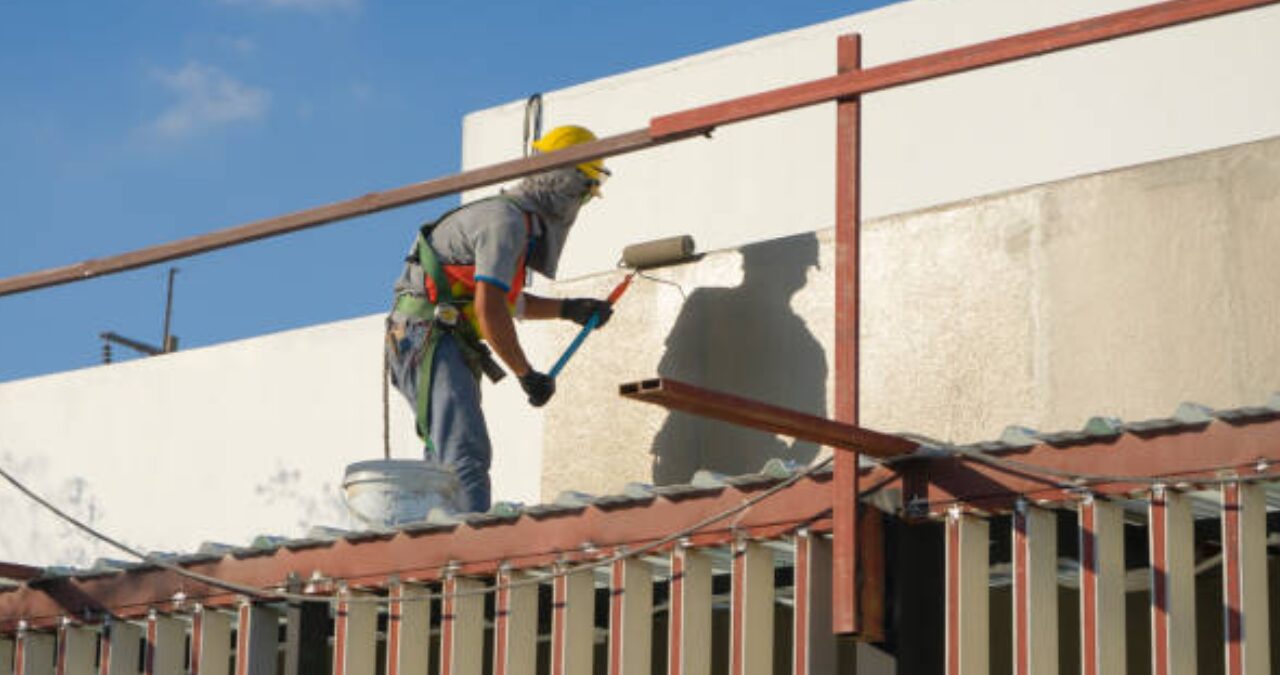
You approved a repaint two or three years ago. The building looked sharp. Clean lines. Fresh color. It felt like money well spent.
Now you’re seeing fading, peeling, rust stains, or chalky residue on the walls. And you’re asking the same question many facility managers and property owners ask:
If you manage manufacturing plants, distribution centers, schools, athletic facilities, or retail stores in the Southeast, this happens more often than expected. The issue usually isn’t just “bad paint.” It usually runs deeper.
Paint in Commercial Buildings Is Protection, Not Decoration
In industrial and commercial facilities, paint does more than improve appearance. It protects surfaces from moisture, UV exposure, corrosion, chemicals, and heavy wear.
Exterior coatings help shield siding, concrete, and steel from rain and sun. Interior coatings in warehouse painting projects protect structural steel, walls, and ceilings from humidity and daily operations.
When those coatings break down early, one or more root causes are usually involved: poor preparation, the wrong product, harsh climate exposure, or incorrect application.

Surface Preparation Was Likely the Weak Link
Most early repaint cycles trace back to inadequate preparation.
In professional industrial painting services, surface prep accounts for the majority of long-term performance. If rust, oil, chalking, dust, or loose paint wasn’t completely removed, the new coating never bonded correctly.
In the Southeast, humidity speeds up corrosion under weak spots. That’s why commercial painting contractors should be able to explain exactly how they cleaned, blasted, or primed the surface.
Shortened prep time lowers labor costs upfront. It usually shortens coating life as well.
The Coating May Not Match the Environment
Another common issue is product selection.
Not all commercial painting companies use high-performance systems. Some projects receive materials designed for light-duty conditions, not manufacturing plants or distribution centers.
Facilities in the Southeast deal with heavy rainfall, long hot summers, and high humidity. Interior warehouse painting may also face condensation, forklift traffic, and chemical exposure.
Standard coatings often cannot handle those conditions for long periods. Industrial painting services should recommend systems based on exposure level, substrate type, and maintenance goals. When a lower-grade product is used to reduce cost, the repaint cycle often arrives much sooner.
How Long Should Commercial Paint Last?
Exterior commercial coatings commonly last seven to twelve years under normal conditions. Interior warehouse painting can last five to ten years depending on traffic and exposure. Industrial steel systems may last ten to fifteen years with proper prep and correct materials.
If you’re repainting every two to four years, something in the process was misaligned.
What Should You Do Now?
Start with an evaluation instead of assuming a full repaint is required. Early failure may be isolated to high-moisture or high-traffic areas.
Review where deterioration is happening. Is it concentrated near loading docks, south-facing walls, or areas exposed to chemicals? Patterns often reveal the underlying cause.
When choosing industrial painting contractors like Southeast Painters, you can ask direct questions about preparation standards, coating specifications, and environmental controls. Experienced industrial painting services should explain their approach clearly and back it up with documentation.
If your commercial building needs repainting sooner than expected, the issue usually comes down to preparation, product choice, climate exposure, or application quality.
For facility managers and plant engineers, the better question isn’t how quickly the next project can start. It’s how to design a system that performs for the full intended lifespan.
When good painting contractors focus on durable systems, climate awareness, and thorough prep, repaint cycles become predictable and budgets stay more stable.
