
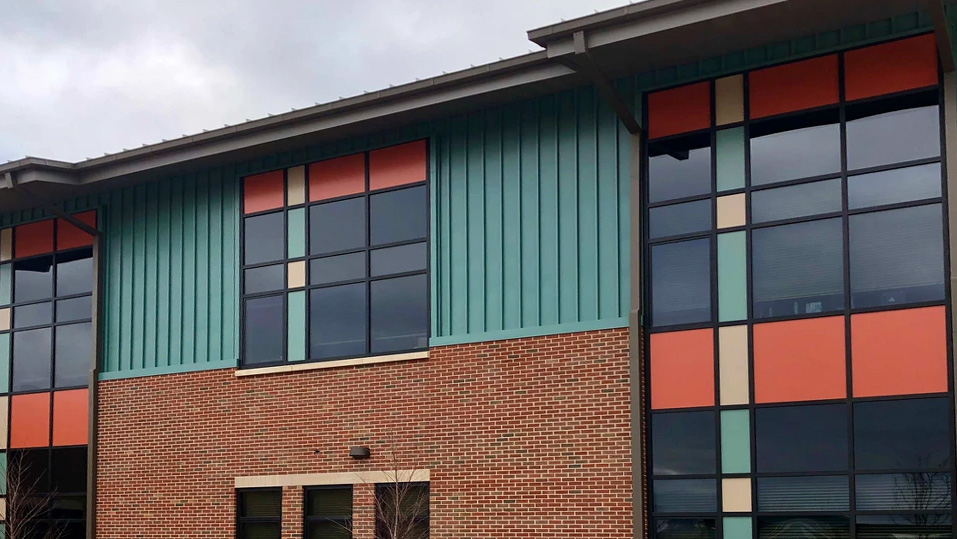
Painting a school is not the same as painting an office building or a retail store. The stakes are different. The schedule is different. The products have to be different. Every decision a school painting contractor makes, from the coatings on the walls to the week the crew shows up, has to account for the fact that hundreds or thousands of children will be spending their days inside that building.
If you manage a school facility, sit on a school board, or oversee maintenance for a district in Tennessee, Georgia, or Alabama, understanding what separates a qualified school painting contractor from a general commercial painter can save you time, money, and a lot of headaches. This guide covers what the process looks like from start to finish, what products belong in a school environment, how scheduling works around the academic calendar, and why surface preparation matters just as much in a classroom as it does in a warehouse.
Why Do Schools Need a Specialized Painting Contractor?
A school building takes a beating in ways that most commercial properties do not. Hallways see foot traffic from hundreds of students every single day. Cafeteria walls get hit with food, cleaning chemicals, and moisture on a daily cycle. Gymnasium walls absorb impacts from balls, equipment, and bodies. Restrooms require coatings that can handle aggressive disinfection schedules without breaking down.
On top of that wear and tear, schools have strict requirements around indoor air quality. Children are more sensitive to chemical exposure than adults, and parents, administrators, and regulatory agencies all expect the products used inside a school to meet rigorous safety standards. A school painting contractor has to understand these requirements and build them into the project from the very beginning, not treat them as an afterthought.
According to industry guidelines, educational facilities represent one of the most demanding commercial painting environments because they combine high-traffic durability needs with the strictest indoor air quality standards of any building type.
What Kind of Paint Belongs Inside a School?
The single most important product decision in a school painting project is choosing coatings with low or zero volatile organic compound (VOC) content. VOCs are the chemicals in conventional paints that off-gas during and after application, and they can cause respiratory irritation, headaches, and allergic reactions, especially in young children whose lungs are still developing.
A qualified school painting contractor specifies low-VOC or zero-VOC products that meet current EPA guidelines and third-party certification standards. These modern formulations deliver the same durability, coverage, and washability as conventional coatings without the harmful off-gassing.
Beyond VOC content, the coatings used in schools need to hold up to constant abuse. Commercial-grade paints like Sherwin-Williams ProMar 200 and Multi-Surface Acrylic are workhorses in education environments. ProMar 200 provides excellent coverage and washability on interior walls and ceilings, while Multi-Surface Acrylic handles doors, trim, and high-touch surfaces where scuffing and fingerprints are a daily reality. Southeast Painters used both of these products throughout the East Brainerd Elementary project in Chattanooga, coating interior concrete walls, masonry, gypsum board, and doors across the entire facility.
How Does Scheduling Work Around the Academic Calendar?
This is where school painting projects get tricky. The ideal window for large-scale school painting is summer break, which typically runs 10 to 12 weeks in most districts across Tennessee, Georgia, and Alabama. That sounds like a generous timeline, but once you factor in surface preparation, concrete and masonry repairs, primer coats, finish coats, and proper cure time, it gets tight quickly.
A school painting contractor who has done this before knows how to reverse-schedule from the non-negotiable completion date: the day students walk back into the building. Every task gets planned backward from that deadline, with built-in buffers for weather delays on exterior work and cure-time requirements between coats.
For smaller projects, winter break and spring break offer shorter windows of 2 to 3 weeks. These work well for refreshing individual classrooms, administrative offices, or common areas without disrupting the full campus.
Southeast Painters has experience coordinating large-scale commercial painting projects around tight operational schedules. We phase work to keep portions of the facility accessible when needed, and we schedule crews for after-hours and weekend shifts to stay on track without interfering with school operations.
What Does Surface Preparation Look Like in a School?
Surface preparation in a school follows the same fundamental principles as any commercial or industrial painting project: the coating is only as good as the surface underneath it. But schools present a specific mix of substrates that require targeted preparation.
Concrete and Masonry Walls
Many school buildings, especially older ones, have concrete block or masonry walls throughout hallways, stairwells, and common areas. These surfaces need to be cleaned, repaired, and primed before finish coats go on. Any cracks, chips, or mortar joint failures need to be addressed first. If previous coatings are peeling or failing, they need to be removed down to sound substrate. Professional surface preparation methods like light abrasive blasting or chemical stripping may be needed for walls with multiple layers of old paint.
Gypsum Board (Drywall)
Classrooms, offices, and newer construction typically feature gypsum board walls and ceilings. These surfaces need patching, sanding, and priming at any damaged or repaired areas before coating. Nail pops, screw holes, dents, and tape joint failures are common in school environments where walls take daily contact from students, furniture, and equipment.
Doors and Metal Surfaces
Hollow metal doors, door frames, and metal stair components are high-touch, high-impact surfaces in every school. They need to be cleaned, sanded or scuffed, and primed with the right bonding primer before a durable finish coat goes on. Multi-Surface Acrylic and industrial enamel coatings are standard choices for these surfaces because they resist chipping, scuffing, and the constant opening and closing that school doors endure.
What Areas of a School Need the Most Attention?
Not every surface in a school wears at the same rate. A school painting contractor who understands education facilities knows where to prioritize.
Hallways and Corridors
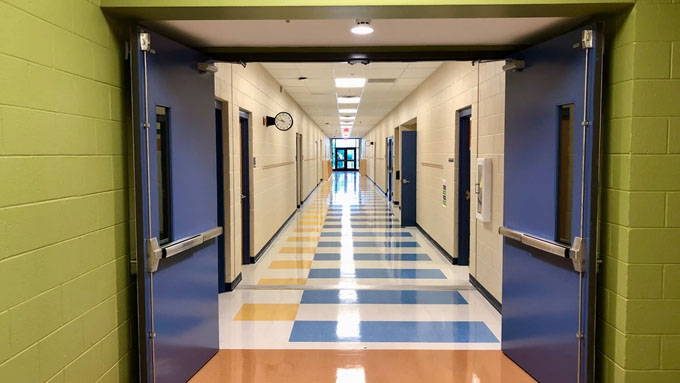
These are the highest-traffic areas in any school. Walls in hallways take constant contact from backpacks, hands, shoulders, and rolling carts. They need coatings that are highly washable and scuff-resistant. A semi-gloss or satin finish makes cleaning easier and holds up better than flat finishes in these zones.
Cafeterias and Kitchens
Food service areas need coatings that resist moisture, grease, and frequent cleaning with commercial-grade disinfectants. Walls and ceilings in these spaces often benefit from the same epoxy and specialty coatings used in commercial food service environments.
Gymnasiums and Athletic Spaces
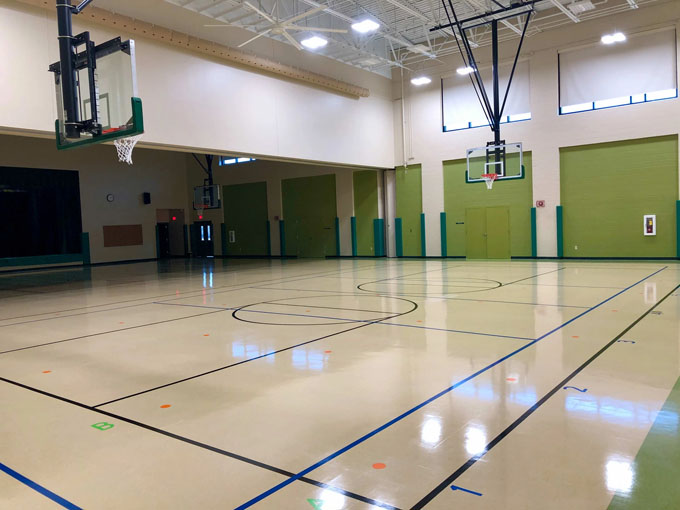
Gym walls need impact-resistant coatings that can handle ball strikes and equipment contact without chipping or cracking. These areas also tend to have higher moisture levels from physical activity, which means the coating system needs to breathe and resist moisture buildup.
Restrooms
School restrooms require coatings that stand up to aggressive daily cleaning schedules and high moisture levels. Semi-gloss finishes and moisture-resistant formulations are standard for these spaces.
Exteriors
School exteriors face the same weather exposure as any commercial building in the Southeast: intense summer heat, high humidity, heavy rain, and occasional freeze-thaw cycles in the winter months. A quality exterior coating protects the building envelope, prevents moisture intrusion, and keeps the campus looking professional and well-maintained.
What Should You Look for in a School Painting Contractor?
Not every commercial painter is equipped to handle a school project. Here is what to look for when evaluating contractors for an education facility.
Experience with education facilities is the first qualification. A contractor who has painted schools before understands the scheduling constraints, the product requirements, the safety protocols, and the coordination it takes to work inside a building that belongs to a community. Southeast Painters has direct experience with education projects, including the full interior recoating of East Brainerd Elementary in Chattanooga, the largest school in Hamilton County with over 1,200 students. That project involved coating every interior surface, including concrete and masonry walls, gypsum board, doors, and miscellaneous metals, as part of a complete rebuild following tornado damage in 2020.
Safety compliance is non-negotiable. Your school painting contractor should carry full insurance, follow OSHA protocols, and have a documented safety program. Workers should be background-checked when working in or around school facilities.
Product knowledge matters. The contractor should be able to specify the right low-VOC products for each surface type, explain why those products are appropriate, and stand behind the coating system they recommend. Southeast Painters works with Sherwin-Williams products across our commercial and industrial painting projects, and we specify the right product for each substrate and environment.
Project management capability is critical. A school painting contractor needs to coordinate with general contractors, architects, school administrators, and maintenance staff. They need to manage crews across multiple areas of the building, phase work around occupied spaces when necessary, and deliver on deadline without cutting corners.
Frequently Asked Questions About School Painting Contractors
What type of paint is safe for schools?
Low-VOC and zero-VOC paints that meet current EPA guidelines are the standard for school environments. Products like Sherwin-Williams ProMar 200 and Multi-Surface Acrylic are commonly used in education facilities because they combine low chemical emissions with the durability needed for high-traffic school environments.
When is the best time to paint a school?
Summer break is the primary window for large-scale school painting projects, offering 10 to 12 weeks for comprehensive work. Winter and spring breaks provide shorter 2- to 3-week windows for smaller refresh projects. An experienced school painting contractor will reverse-schedule every task from the date students return.
How long does it take to paint a school?
The timeline depends on the size of the facility, the condition of existing surfaces, and the scope of work. A full interior recoat of a large elementary or middle school can take 6 to 10 weeks when surface preparation, repairs, priming, and finish coats are all included.
Can you paint a school while it is occupied?
Yes, with the right planning. Work can be phased so that crews are painting in unoccupied sections of the building while classes continue in other areas. Low-VOC products, proper ventilation, and physical barriers between work zones and occupied spaces are all essential when painting during partial occupancy.
Does Southeast Painters work on school projects?
Yes. Southeast Painters has experience painting education facilities in the Chattanooga area and across the Southeast, including the full interior recoat of East Brainerd Elementary. We use low-VOC Sherwin-Williams products, coordinate with general contractors and school administrators, and schedule work around the academic calendar. Contact us for a free estimate.
Give Your School the Finish It Deserves
Your school building is where your community sends its children every day. It should look clean, feel safe, and reflect the pride your district puts into education. Whether your facility needs a full interior recoat, exterior refresh, or targeted work on high-traffic areas, choosing the right school painting contractor makes the difference between a job that lasts and one that has to be redone in two years.
Southeast Painters has been providing commercial and industrial painting services across the Southeast for more than 30 years. We understand the products, the process, and the scheduling it takes to deliver a school painting project on time and on budget.
Call us at (423) 558-3842, email us at info@southeastpainters.com, or request your free estimate online. Let us help you protect and refresh the spaces where your students learn.
Southeast Painters
3535 St. Elmo Avenue, Chattanooga, TN 37409
(423) 558-3842 | info@southeastpainters.com
www.southeastpainters.com
